
Full Text
This study aimed to assess the mastery of the competencies of the 7th-grade students undergoing Modular Instruction using the 7th Grade English Most Essential Learning Competencies (MELCs). This study aims to confirm Robert Gagne's Theory of Instruction (1985), which claims that learning conditions and arrangements must be considered in the learning outcomes. It highlights the different levels of learning in which each class has its type of instruction and Conditions of Learning theory, where internal and external conditions play a vital role in grasping the students' learning. The study also based itself on the Outcome-Based Educational Theory of William G. Spady and Jerome Bruner's Constructivist Theory and Spiral Progression. The study utilized a descriptive survey - correlational research design. In deciding the sample size for the data collection process, the proponents used convenience sampling methods due to the challenges brought by the COVID-19 pandemic. Respondents were asked to answer a 60-item summative test covering all the topics in the first grading of 7th grade English Most Essential Learning Competencies (MELCs). The results showed that only one participant passed out of 120 who took the summative test. It also revealed that the most mastered competency was the "use passive and active voice meaningfully in varied contexts." In contrast, the least mastered competencies "Identify the genre, purpose, intended audience and
features of various viewed texts such as movie clip, trailer, newsflash, internet-based program, documentary" and "Supply other words or expressions that complete an analogy." It also revealed that all
participants agreed that factors of learning environment, learning materials, and learning outcome had contributed significantly to their mastery of the competencies delivered by modular instruction under the
MELCS as it had a total mean of 3.59 and a standard deviation of 0.51. A positive correlation was also found between the student's perception of modular instruction and their actual performance on the
summative exam. The study's proponents recommend an action plan intervention activity that will address the least learned competencies of Grade 7. Further, they recommend further studies on the specific causes
that have affected the academic performances, why the participants performed poorly in the least mastered competencies, and the students' perceptions of why they perceive modular instruction as an efficient method of instruction.
features of various viewed texts such as movie clip, trailer, newsflash, internet-based program, documentary" and "Supply other words or expressions that complete an analogy." It also revealed that all
participants agreed that factors of learning environment, learning materials, and learning outcome had contributed significantly to their mastery of the competencies delivered by modular instruction under the
MELCS as it had a total mean of 3.59 and a standard deviation of 0.51. A positive correlation was also found between the student's perception of modular instruction and their actual performance on the
summative exam. The study's proponents recommend an action plan intervention activity that will address the least learned competencies of Grade 7. Further, they recommend further studies on the specific causes
that have affected the academic performances, why the participants performed poorly in the least mastered competencies, and the students' perceptions of why they perceive modular instruction as an efficient method of instruction.

ASSESSING THE LEVEL OF OCCUPATIONAL STRESS AMONG OFFICE- BASED EMPLOYEES OF UNITED DRIVERS AND OPERATORS TRANSPORT COOPERATIVE IN P. RODRIGUEZ ST., LAPU-LAPU CITY
Views: 114, Downloads: 1
Alignment of the USJ-R BSA and BSMA 4th Year Students’ IT Skills with the Entry-level IT Skills Deemed Important in the Accounting Industry in Cebu City, Philippines
Views: 105, Downloads: 1
FACTORS INFLUENCING GULLIBLE ACTS IN INVESTMENT FRAUD PARTICIPATION AMONG 3 BUSINESS STUDENTS IN CEBU CITY
Views: 74, Downloads: 4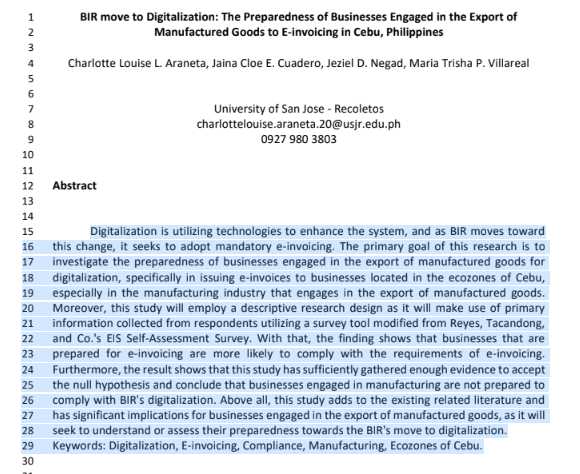
BIR move to Digitalization: The Preparedness of Businesses Engaged in the Export of Manufactured Goods to E-invoicing in Cebu, Philippines
Views: 66, Downloads: 1