
Full Text
Digitalization is utilizing technologies to enhance the system, and as BIR moves toward this change, it seeks to adopt mandatory e-invoicing. The primary goal of this research is to investigate the preparedness of businesses engaged in the export of manufactured goods for
digitalization, specifically in issuing e-invoices to businesses located in the ecozones of Cebu, especially in the manufacturing industry that engages in the export of manufactured goods. Moreover, this study will employ a descriptive research design as it will make use of primary information collected from respondents utilizing a survey tool modified from Reyes, Tacandong, and Co.'s EIS Self-Assessment Survey. With that, the finding shows that businesses that are prepared for e-invoicing are more likely to comply with the requirements of e-invoicing. Furthermore, the result shows that this study has sufficiently gathered enough evidence to accept the null hypothesis and conclude that businesses engaged in manufacturing are not prepared to comply with BIR's digitalization. Above all, this study adds to the existing related literature and has significant implications for businesses engaged in the export of manufactured goods, as it will seek to understand or assess their preparedness towards the BIR's move to digitalization. Digitalization, E-invoicing, Compliance, Manufacturing, Ecozones of Cebu.
digitalization, specifically in issuing e-invoices to businesses located in the ecozones of Cebu, especially in the manufacturing industry that engages in the export of manufactured goods. Moreover, this study will employ a descriptive research design as it will make use of primary information collected from respondents utilizing a survey tool modified from Reyes, Tacandong, and Co.'s EIS Self-Assessment Survey. With that, the finding shows that businesses that are prepared for e-invoicing are more likely to comply with the requirements of e-invoicing. Furthermore, the result shows that this study has sufficiently gathered enough evidence to accept the null hypothesis and conclude that businesses engaged in manufacturing are not prepared to comply with BIR's digitalization. Above all, this study adds to the existing related literature and has significant implications for businesses engaged in the export of manufactured goods, as it will seek to understand or assess their preparedness towards the BIR's move to digitalization. Digitalization, E-invoicing, Compliance, Manufacturing, Ecozones of Cebu.

ASSESSING THE LEVEL OF OCCUPATIONAL STRESS AMONG OFFICE- BASED EMPLOYEES OF UNITED DRIVERS AND OPERATORS TRANSPORT COOPERATIVE IN P. RODRIGUEZ ST., LAPU-LAPU CITY
Views: 113, Downloads: 1
Alignment of the USJ-R BSA and BSMA 4th Year Students’ IT Skills with the Entry-level IT Skills Deemed Important in the Accounting Industry in Cebu City, Philippines
Views: 103, Downloads: 1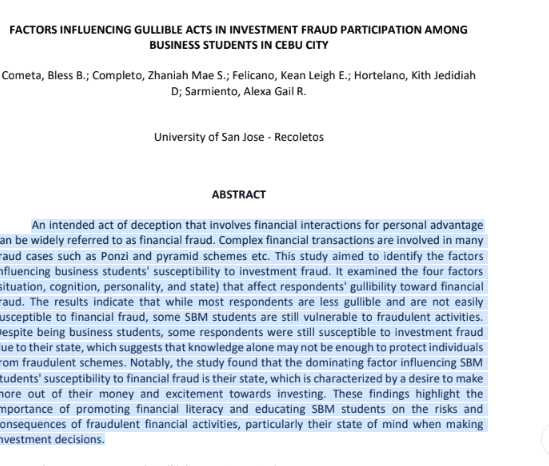
FACTORS INFLUENCING GULLIBLE ACTS IN INVESTMENT FRAUD PARTICIPATION AMONG 3 BUSINESS STUDENTS IN CEBU CITY
Views: 74, Downloads: 4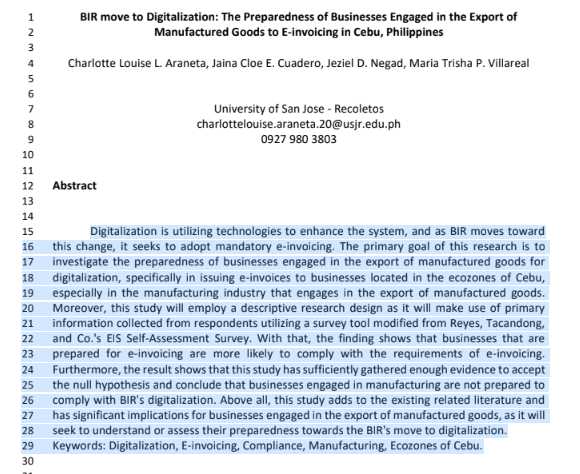
BIR move to Digitalization: The Preparedness of Businesses Engaged in the Export of Manufactured Goods to E-invoicing in Cebu, Philippines
Views: 66, Downloads: 1