
Full Text
This study investigates the trend of family-owned firms' financial performance after the transition into IPO specifically in terms of profitability using selected performance indicators (net revenue, gross profit, net income, and stock prices). For this purpose, the researchers used a statistical method called the trend analysis. Trend analysis determines the patterns and changes of performance among family owned businesses utilizing five periods after its prior IPOs listing date. Our findings reveal that the three components of income statements mainly the net revenue, gross
16 profit, net income and stock value as firm performance indicators yield the same results wherein we discover that the financial performance of family owned businesses commonly declines after going public. It was clear that family firms were not well positioned as they engaged in the market knowing that in its first 5 years it resulted in consistent declines. Our analysis concludes that the family-firms financial performance in terms of the firm's profitability is in a downtrend direction. Family firms' market value tends to reduce due to negative perceptions aside from experiencing adversity in dealing with market timing, it is also with the notion of the negative family control perceptions among its investors.
16 profit, net income and stock value as firm performance indicators yield the same results wherein we discover that the financial performance of family owned businesses commonly declines after going public. It was clear that family firms were not well positioned as they engaged in the market knowing that in its first 5 years it resulted in consistent declines. Our analysis concludes that the family-firms financial performance in terms of the firm's profitability is in a downtrend direction. Family firms' market value tends to reduce due to negative perceptions aside from experiencing adversity in dealing with market timing, it is also with the notion of the negative family control perceptions among its investors.

ASSESSING THE LEVEL OF OCCUPATIONAL STRESS AMONG OFFICE- BASED EMPLOYEES OF UNITED DRIVERS AND OPERATORS TRANSPORT COOPERATIVE IN P. RODRIGUEZ ST., LAPU-LAPU CITY
Views: 114, Downloads: 1
Alignment of the USJ-R BSA and BSMA 4th Year Students’ IT Skills with the Entry-level IT Skills Deemed Important in the Accounting Industry in Cebu City, Philippines
Views: 105, Downloads: 1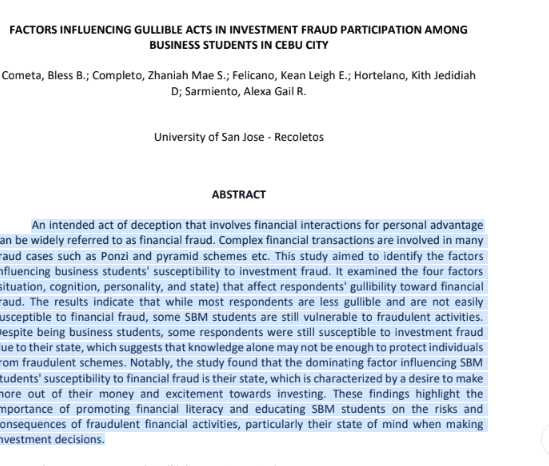
FACTORS INFLUENCING GULLIBLE ACTS IN INVESTMENT FRAUD PARTICIPATION AMONG 3 BUSINESS STUDENTS IN CEBU CITY
Views: 74, Downloads: 4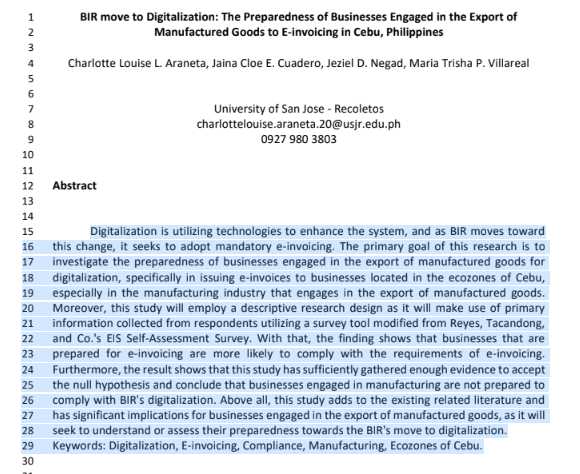
BIR move to Digitalization: The Preparedness of Businesses Engaged in the Export of Manufactured Goods to E-invoicing in Cebu, Philippines
Views: 66, Downloads: 1