
Full Text
The study of tax morale has been a critical topic among accounting researchers and economists. This paper adds to this body of literature by examining the taxonomy of social norms concerning the level of tax morale. Motivated by two theories: social norm theory and theory of planned behavior, this study tests the relationship among social norms and tax morale behavior. This study provides new evidence on how the four social norms by Cialdini and Trost (1998) affect tax morale of self-employed individuals in the highly urbanized cities in the Province of Cebu. The data was gathered through a hybrid method (physical and online-based) and used multiple regression analysis. The method and analysis used the responses of 150 self-employed individuals engaged in business and the practice of a profession. The results are precious in interpreting the influence of social norms because the respondents have high tax morale, and social norms significantly influence their level of tax morale. Results are highly significant, wherein policymakers can leverage social norms. The influence of significant others (family, friends, spouses) can help increase tax morale of self-employed, ultimately leading to higher tax revenues.

ASSESSING THE LEVEL OF OCCUPATIONAL STRESS AMONG OFFICE- BASED EMPLOYEES OF UNITED DRIVERS AND OPERATORS TRANSPORT COOPERATIVE IN P. RODRIGUEZ ST., LAPU-LAPU CITY
Views: 114, Downloads: 1
Alignment of the USJ-R BSA and BSMA 4th Year Students’ IT Skills with the Entry-level IT Skills Deemed Important in the Accounting Industry in Cebu City, Philippines
Views: 105, Downloads: 1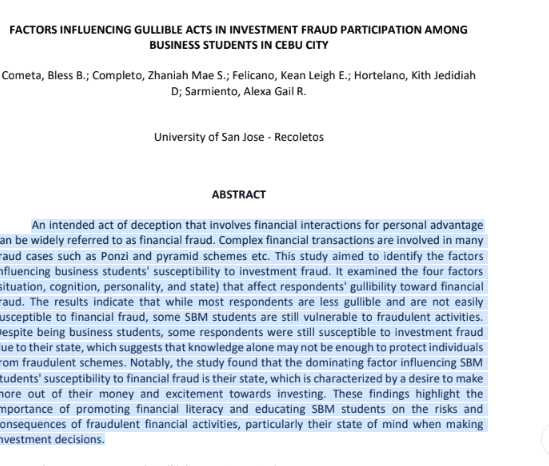
FACTORS INFLUENCING GULLIBLE ACTS IN INVESTMENT FRAUD PARTICIPATION AMONG 3 BUSINESS STUDENTS IN CEBU CITY
Views: 74, Downloads: 4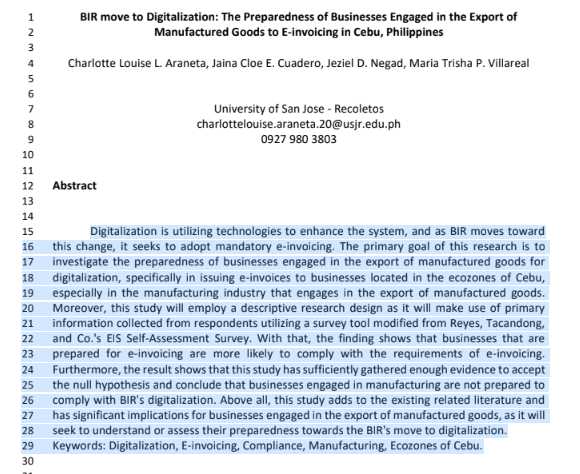
BIR move to Digitalization: The Preparedness of Businesses Engaged in the Export of Manufactured Goods to E-invoicing in Cebu, Philippines
Views: 66, Downloads: 1