
Full Text
The Bank Secrecy Laws (R.A 1405 and R.A 6426) were enacted to promote deposits by ensuring absolute confidentiality with exceptions noted under Section 2 of the law. These laws play a crucial role in safeguarding an individual's right to privacy. Thus, thisstudy aims to scrutinize the weaknesses of government institutions in prosecuting money laundering in the face of bank secrecy laws. The researchers used two theories to determine whether banks have become a haven for illegal acts and whether they are insufficiently or excessively reporting suspicious transactions to government agencies. Additionally, the inductive research approach was used to provide a general proposition on how the Bank Secrecy Laws are construed in relation to the cases. The ten cases examined involve money laundering offenses and invoking Bank Secrecy asa defense, which date back from 1955, to when the Bank Secrecy Act was enacted. A criterion was followed, and online jurisprudence e-libraries were used to probe money laundering, graft, and corruption cases that involve bank secrecy laws. Results show that banks are willing to cooperate in disclosing an individual's financial information. However, banks were in a dilemma regarding what laws were applicable. Insufficient grounds for a bank inquiry order prove a delay in prosecuting cases requiring additional evidence to support claims against the defendants. Moreover, the limited exception of the FCDA is a loophole for money launderers to dodge prosecution by keeping their ill-gotten funds in foreign currency accounts. Further, weaknesses of the AMLC and other government institutions were the failure to establish sufficient groundsfor the subpoena and to acknowledge the individuals' rights. Therefore, the researchers support the calls for legislative reformations to the Bank Secrecy Laws that would aid government institutions in investigating illicit acts without impeding their courses of action.

ASSESSING THE LEVEL OF OCCUPATIONAL STRESS AMONG OFFICE- BASED EMPLOYEES OF UNITED DRIVERS AND OPERATORS TRANSPORT COOPERATIVE IN P. RODRIGUEZ ST., LAPU-LAPU CITY
Views: 114, Downloads: 1
Alignment of the USJ-R BSA and BSMA 4th Year Students’ IT Skills with the Entry-level IT Skills Deemed Important in the Accounting Industry in Cebu City, Philippines
Views: 104, Downloads: 1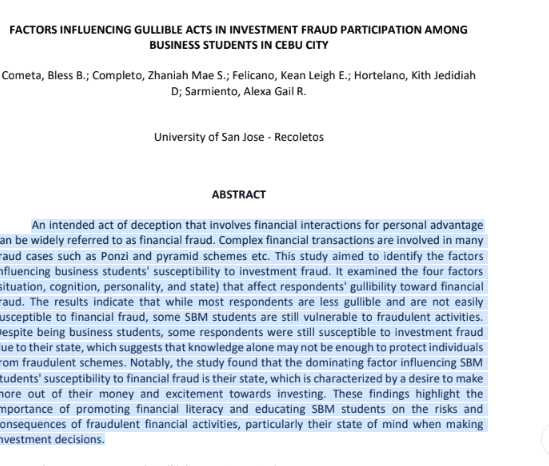
FACTORS INFLUENCING GULLIBLE ACTS IN INVESTMENT FRAUD PARTICIPATION AMONG 3 BUSINESS STUDENTS IN CEBU CITY
Views: 74, Downloads: 4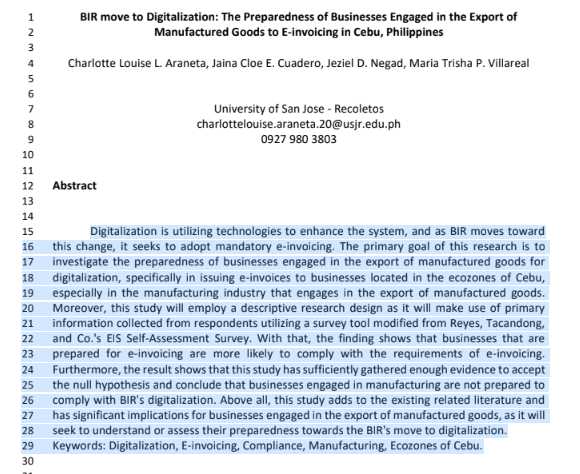
BIR move to Digitalization: The Preparedness of Businesses Engaged in the Export of Manufactured Goods to E-invoicing in Cebu, Philippines
Views: 66, Downloads: 1